The Question Is Not Whether to Pay, It's How to Pay.
Prop 497 offers a more equitable way to share the costs and can lower property taxes. It is important that you understand how it works.
If your first reaction to Prop 497 is “Not another tax,” take a closer look. Yavapai County voters are already paying this cost through two separate tax sources. First, with the existing Jail District sales tax of ¼ cent that does not cover the cost of operating the jail system. Second, with millions of additional dollars from the County General Fund (property tax) that are subsidizing the sales tax shortfall.
Prop 497 offers a choice in how this funding is sourced and offers a broader-based and more equitable solution. The costs are not negotiable because they are essential for our public safety. How we pay for them is.
The Funding Choice

Prop 497 would change how that $16.15 million shortfall is funded. Instead of continuing to rely on approximately $16.15 million from the General Fund, Prop 497 would add a ¼-cent Jail District sales tax to cover the full cost of jail operations. This would reduce reliance on the General Fund and allow those dollars to remain available for other County priorities, such as roads and other services.
To be transparent, there is another General Fund contribution to the Jail District that Prop 497 does not change. Under Arizona’s statutory “Maintenance of Effort” requirement, Yavapai County is required to contribute approximately $8.88 million annually from the General Fund to the Jail District. That required contribution will continue from the General Fund whether Prop 497 passes or not.


Yavapai County voters approved the current ¼-cent Jail District sales tax in 1999 — nearly 28 years ago. Today, it no longer generates enough revenue to cover the cost of operating the County’s jail system. The County estimates that the Jail District requires approximately $41.44 million annually to operate. The shortfall is significant.
To make up the shortfall, the County pays approximately $16.15 million each year from the General Fund to the Jail District. That matters because the General Fund is funded primarily by property taxes which are collected to pay for many other County responsibilities and services.
You Choose How Our Jail System is Funded
.jpg)
Sales Tax:
A Better Choice

The Jail District sales tax is a dedicated source of funding for Yavapai County’s jail system. Unlike the General Fund, which comes mostly from local property taxes, sales tax is paid by everyone making taxable purchases in the County, not just property owners. Sales tax includes property owners, renters, visitors, and tourists.

-
Prop 497 increases the Jail District sales tax from ¼ cent to ½ cent per dollar of taxable sales. It would begin July 1, 2027, and sunsets in 20 years.
-
The County Budget Office reports that approximately 20% of County sales tax is paid by visitors from outside Yavapai County.
-
Prop 497 broadens the base of those paying the cost of the public-safety system. Increased sales tax revenue will alleviate pressure on the General Fund and ultimately replace it. Sales tax will grow exponentially to offset our growing population and inflation.
-
Items that are exempt from sales tax include food for home consumption, prescription drugs, medical devices, and most services
-
To be fair to the residents of Yavapai County, it is important to note that our jails house 20% of their inmates from outside our county.

A No Vote Won't
Make it Go Away
Prop 497 does not create a new obligation to fund the Jail District. That obligation already exists and it must be funded. Prop 497 gives voters a choice about how that existing expense is funded.
A NO vote does not reduce or eliminate Jail District operating costs. It means the County must continue using General Fund dollars to cover the shortfall between existing Jail District sales tax revenue and the cost of operating the jail system.
If operating costs continue to rise and existing Jail District sales tax revenue does not keep pace, the amount required from the General Fund could increase over time. Continuing to draw more from the General Fund could place additional pressure on property tax revenues in the future.

The Property
Tax Connection
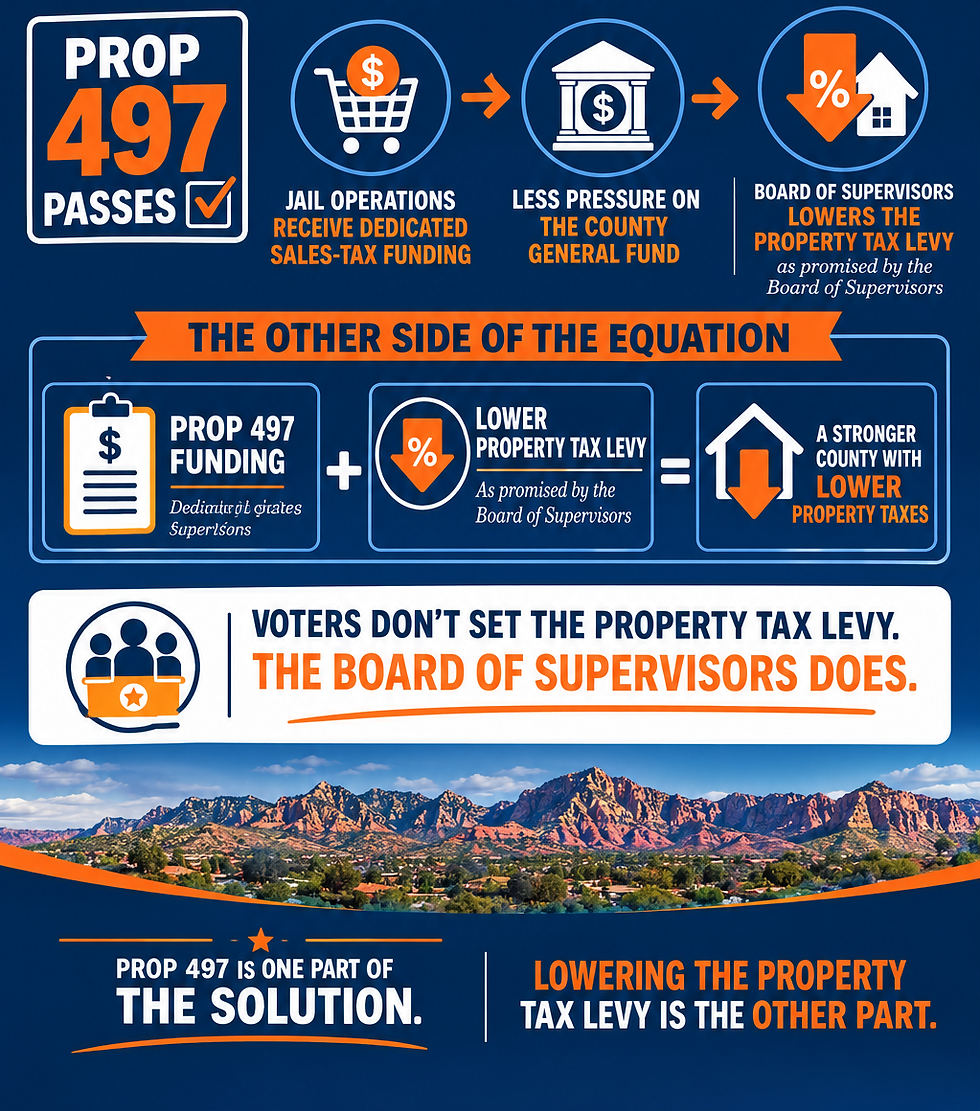
A ballot measure cannot lower property taxes; only The County Board of Supervisors can do that. This is the significant other half of the equation you should consider. It cannot be on the ballot, but it is connected to Yes on Prop 497. The County Board of Supervisors has already promised to lower the property tax levy if Prop 497 passes. As elected officials, the voters can and will hold them to it.

Promises from the
Yavapai County
Board of Supervisors:
Brooks Compton - District 1
"As Chair of the Board of Supervisors, I am committed to lowering the property tax levy if voters pass Prop 497 in November. I fully support Prop 497."
Dee Jenkins - District 2
"When Proposition 497 is approved by the voters, as BOS for District 2, I will vote to reduce your property tax levy."
Nikki Check - District 3
"I will support lowering the primary property tax levy in Yavapai County if Prop 497 passes. As Vice Chair of the Board of Supervisors, I will work to make this change as soon as possible in the 2027 budget cycle should Prop 497 be successful."
Chris Kuknyo - District 4
"Should Prop 497 pass, I would support reducing property taxes accordingly. Switching the burden from only property owners to everyone who lives, works and visits the county seems like the right thing to do."
Mary Mallory - District 5
"As a Supervisor since 2019, you know I keep my word. I am fully committed to lowering the property tax levy next year if prop 497 passes in November."
Prop 497
Frequently Asked Questions

More Than a Jail – A Public Safety Breakthrough
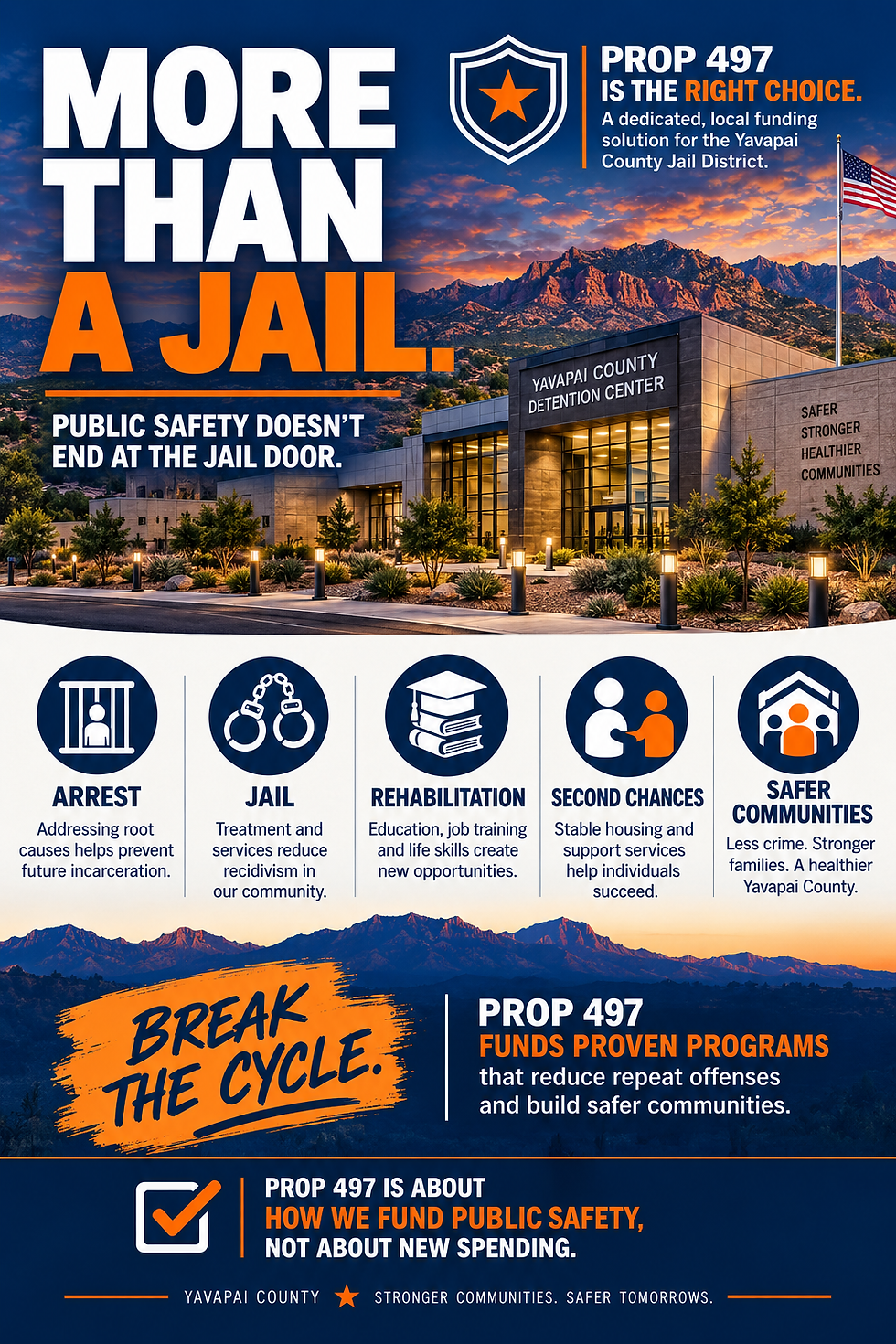
Yavapai County operates detention facilities in Prescott and Camp Verde. Both are part of a broader countywide approach to detention, recovery and re-entry that have proven results that increase public safety. A jail protects the public by securely holding people who must be detained. But most people held in a county jail will eventually return to the community. Public safety therefore depends on reducing the likelihood that they commit another crime. The best possible outcome for our community is that exiting detainees become productive citizens. Our well planned and executed District Jail System provides the following and more:
-
Secure Detention Centers
-
Court Access and Courtrooms
-
Medical Care
-
Suicide Watch
-
Mental Health / Behavioral Health
-
Recovery Programs
-
Reach Out Re-entry Program
-
Connections Services for Exiting Detainees
-
Education and Work Qualification Opportunities

The Public
Safety Results
The goal is not to build more jails; it is to keep our jail population lower by reducing the number of reoffenders. YCSO does this in an efficient, safe, and cost-effective way. They are breaking the cycle of reoffending before it escalates for everyone’s safety. When the Reach Out Program began in 2018, YCSO measured recidivism (rate of released inmates reoffending) at approximately 50%. Sheriff David Rhodes confirms the current rate is 18% which is audited by NAU. That huge reduction in recidivism is testament to the program’s success in just a few short years. It means our Jail System operates efficiently and effectively.
Why Recidivism Should Matter to You
A relatively small number of repeat offenders account for a disproportionate share of crime and the costs that come with it. What may begin with lower-level offenses can escalate into more serious criminal activity over time. Our County Attorney refers to this pattern as “the revolving door.”
Reducing recidivism means interrupting that cycle. Effective programs that address the causes of repeat offending can improve public safety while reducing the strain on our criminal justice system.
Every repeat offense prevented can mean one less potential victim, one less dangerous encounter for law enforcement, one less arrest and prosecution, and one less person returning to jail.
Lower recidivism also reduces jail population size and helps create a safer working environment for our Detention Deputies and staff. Fewer repeat offenses. Fewer victims. Safer communities

.jpg)